Fachbereich Philosophie und Geisteswissenschaften
Service-Navigation

Pfadnavigation
Unrevealing the Mesopotamian Jewish Arabic Dialect Continuum
Assaf Bar-Moshe
In the past millennium, Jews residing in the river basins of the Tigris and the Euphrates conversed in a diverse array of Judeo-Arabic dialects. Classified within the qǝltu group of Mesopotamian Arabic, these dialects exhibit notable distinctions among them. Through a comparative analysis, the project aims to identify these differences and determine whether they signify a dialect continuum. Furthermore, the research endeavors to explore potential common ancestry or contact between Jewish dialects in Mesopotamia and in the northern Levant, despite their geographical dispersion.

Experimental Replication of Historical Reanalysis Processes (EXREAN)
PI: Malte Rosemeyer
EXREAN is a pioneering project that replicates historical reanalysis processes in a lab setting to understand how and why grammatical change occurs.
Bildquellen

EXREAN-banner-2000x850_Seite_2
Bildquelle: —

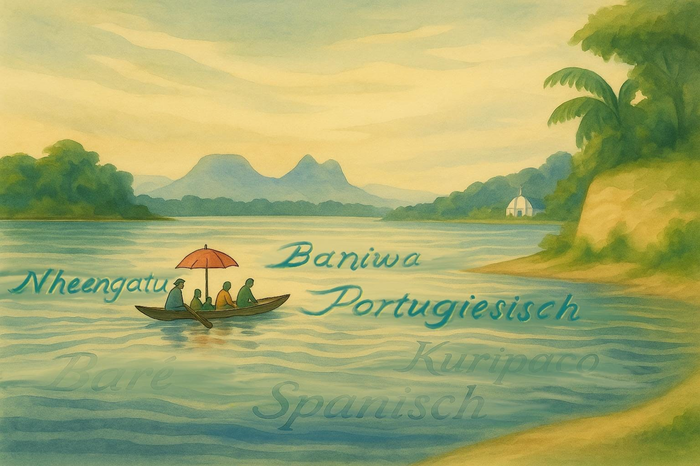
Sprachen im Fluss
Uli Reich & André Amorim
Das Projekt untersucht Modalität und Informationsstruktur in der Tupi-Guarani-Sprache Nheengatu in typologischer Perspektive. Die partizipativ angelegte Methodologie versucht einen Beitrag zur Stärkung der indigenen Autonomie in der Region zu leisten.

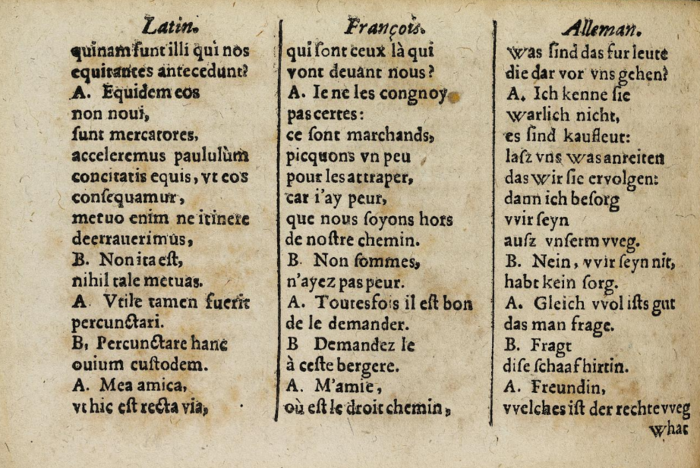
Historische Fremdsprachenlehrwerke digital (FSL digital)
PI Berlin: Horst Simon
Das Langzeitvorhaben widmet sich der Volltexterschließung, korpuslinguistischen Aufbereitung, Annotation, digitalen Vernetzung sowie der sprach-, kultur- und wissenshistorischen Auswertung historischer Fremdsprachenlehrwerke der Frühen Neuzeit, in denen Deutsch Ziel- oder Ausgangssprache ist.

The Discursive Construction of Eating as Entertainment – Carnivalesque Consumption in the Digital Sphere
Sofia Rüdiger & Colleagues (Rita Vallentin).
This project analyzes how popular Anglophone food-excess videos use language to frame overconsumption as entertainment

ProPer geminates in ITA-L2
Andrea Pešková & Colleagues
By means of perception and production data, the project contributes to the research on second language acquisition by exploring how Czech, Finnish, German and Spanish adult (literate) learners acquire (word-internal) consonant length in L2 Italian.
Bildquellen
Reich_Nheengatu
Bildquelle: Maggy Busch
Projektbild_FSL_Simon_et_al
Bildquelle: Colloqvia Et Dictionariolvm Sex Lingvarvm, Latinae, Gallicae, Germanicae, Anglicae, Italicae, & Hispanicae..., Haidelbergae, 1614 | Universitätsbibliothek Heidelberg, Public Domain Mark 1.0

Online_Food_Ruediger_Projektbild
Bildquelle: —

ProPer_Peskova_Projektbild
Bildquelle: —
Adverbial clauses and their dependency relationships
Andreas Pankau
This network project investigates adverbial clauses and their dependency relations from synchronic, diachronic, and typological perspectives, aiming to deepen understanding of subordinate clauses. Meetings explore dependencies between adverbials and matrix clauses, the development, variation, and grammaticalization of adverbial constructions, and non‑canonical functions such as adnominal adverbial clauses and adverbial argument clauses. Emphasis is placed on crosslinguistic comparison, drawing data primarily from Celtic, Germanic, Romance, and Slavic languages, to map patterns, constraints, and theoretical implications for clause subordination and syntax research.
(In)visibility of Multilingualism in Amdo Tibet
Giulia Cabras
This study examines how urban growth, policies, migration, and socioeconomics shape language use in public spaces, focusing on multilingual signage. Combining ethnography, sociolinguistics, and urban studies, it analyzes visibility of Tibetan and Standard Chinese in Rongwo (Longwu), a rapidly urbanizing town in Rebgong, Qinghai. With both languages officially recognized and new infrastructure emerging, the research investigates how state and community needs, ideologies, norms, and language contact create hierarchies and inequalities. It explores minority roles and policy effects on ethnolinguistic representation.
Naming the landscape in the Modern South Arabian languages
Dr. Fabio Gasparini – Institute for Semitic Studies
The cultures and environment of Modern South Arabian Language (MSAL) speakers are threatened by rapid social changes like urbanisation and Arabization, unsustainable development, and climate change. This leads to a loss of traditional knowledge about human–landscape relationships, negatively impacting local culture. The project aims to document and analyse the toponymic and orientation systems of MSAL speakers to preserve this endangered heritage and promote the maintenance of traditional cultural knowledge.
The Birth of Monolingualism from Multilingualism
Matthias Hüning and Anne Fleig
This comparative project investigates the origins of modern monolingualism—“pre‑monolingualism”—and its literary effects by comparing 18th‑century German and 20th‑century Turkish. It examines how standard‑language ideology, national linguistic norms, and reforms (notably Atatürk’s) shaped notions of the mother tongue, literary originality, and purist language practices. Through historical case studies and analysis of contemporary Turkish‑German literature, the study traces continuities and ruptures between pre‑ and post‑monolingual situations, exploring how multilingual realities are represented and negotiated in literary cultures across time, space, and sociopolitical contexts.