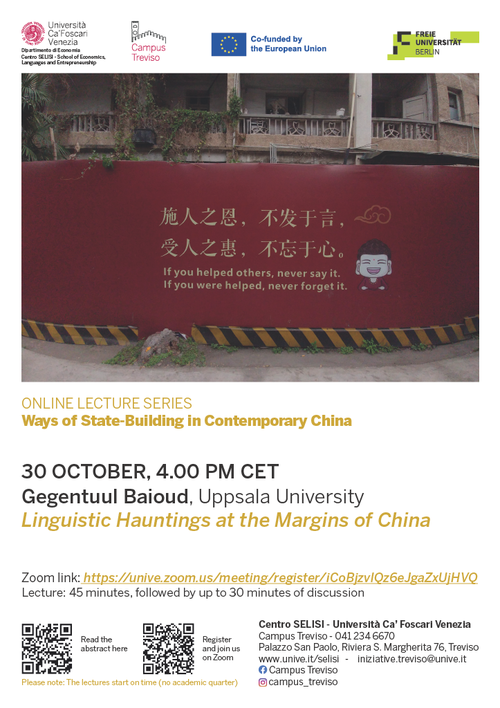
Gegentuul Baioud (Uppsala University): Linguistic hauntings at the margins of China.
Communication co-organized by the University of Venice and the Freie Universität Berlin (Giulia Cabras).
On October 30th, at 16h, Giulia Cabras will organize an online lecture on linguistic landscapes by Gegentuul Baioud.
All are welcome!
The lecture will take place online via Zoom (registration required): https://unive.zoom.us/meeting/register/iCoBjzvlQz6eJgaZxUjHVQ
Abstract:
This study examines emotional and material traces lingering in the aftermath of forced linguistic landscape transformations in Inner Mongolia following the implementation of a new assimilationist national language policy in 2022. Drawing on ethnographic and linguistic landscape data, the study specifically examines how the multilingual signs that have undergone invisibilization or changes in their layouts are accompanied by marginalized senses and excluded voices—linguistic hauntings—in the multilingual Mongolian borderlands. In this study, linguistic hauntings are animated by Mongolian linguistic anxiety and conditioned by the Chinese state's intensified language oppression in transitioning from a multinational and multilingual state to a unified Chinese nation with one singular language. The article suggests that linguistic haunting is a powerful lens for analysing the interlinked political, affective and temporal dimensions in drastically reconfiguring landscapes. The study contributes to the sociolinguistics of the specters, borderlands multilingualism, nationalism and its linguistic entailments.
Gegentuul Baioud is a sociolinguist/linguistic anthropologist and her research focuses on linguistic nationalism, ethnic policy, Mongolian wedding ceremonies, and medical discourse in Inner Mongolia, China. She currently heads the research project “Improvisation and hope in the face of assimilation: Mongolian identities in a changing China”, funded by Riksbankens Jubileumsfond (2023-2027).”